Introducing Awake AI 10B
Read more about Awake AI with 10 billion parameters only for Indian users.
Awake AI-10B
Awake AI-10B is a bilingual large language model developed by Awake Solutions, designed to deliver high-performance reasoning, multilingual understanding, and scalable deployment across real-world environments. With approximately ten billion parameters, the model is engineered to balance capability, efficiency, and alignment, enabling consistent performance across both developer-focused systems and enterprise-grade applications.
The model is designed to operate at the intersection of regional linguistic intelligence and global-scale reasoning capability, with a particular emphasis on bilingual interaction involving Indian languages and English. This positioning enables Awake AI-10B to support a wide range of use cases where linguistic diversity and contextual accuracy are essential.
Model Overview
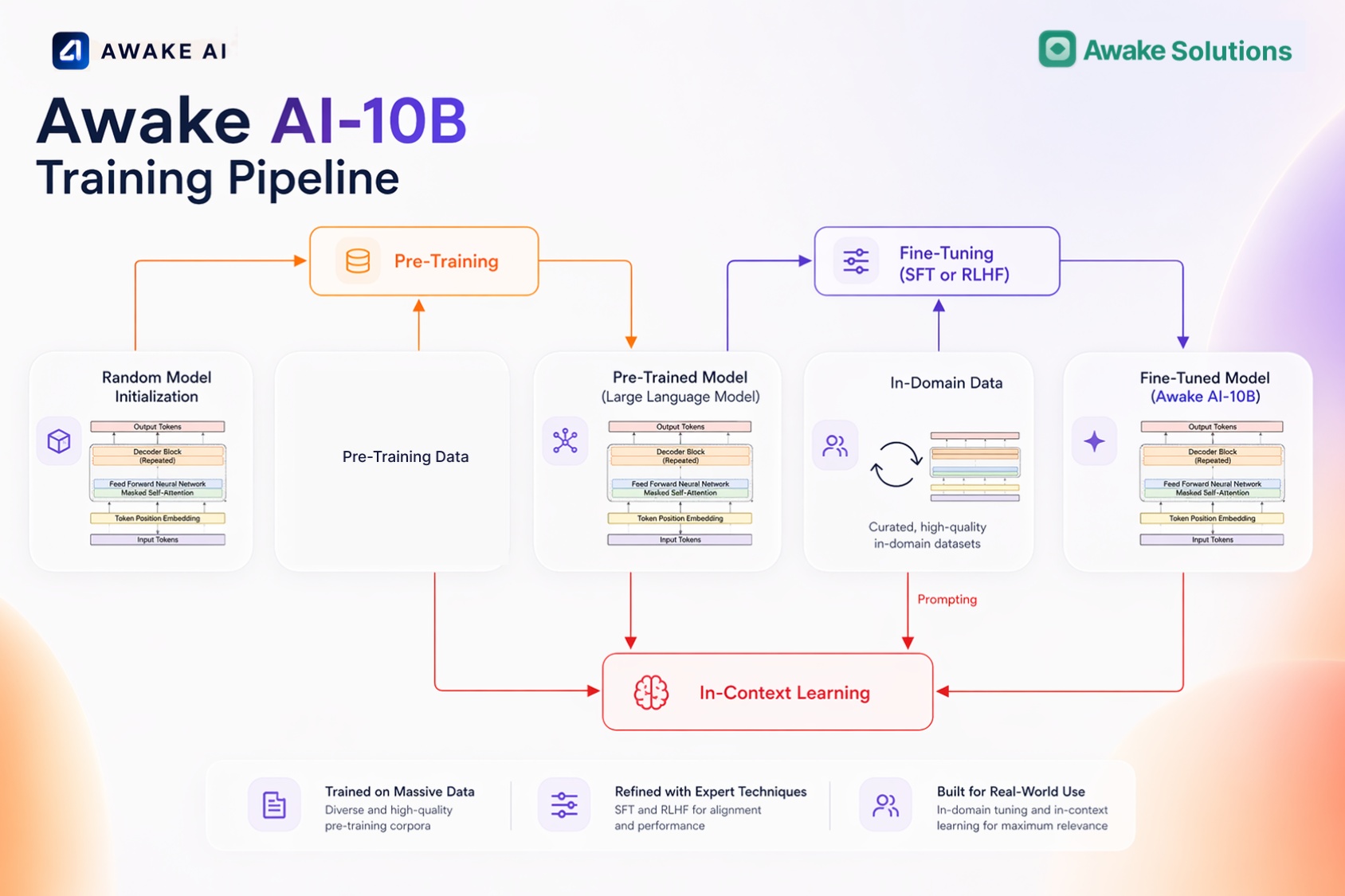
Awake AI-10B is a decoder-only transformer-based language model trained on a diverse mixture of multilingual text, structured knowledge, and programming data. It is optimized for instruction-following, contextual reasoning, and multi-domain adaptability, enabling it to generalize effectively across a broad spectrum of tasks.
The system is designed to interpret complex prompts, maintain coherence across extended interactions, and generate structured outputs that align with user intent. Its training and optimization processes emphasize real-world usability, ensuring that performance extends beyond controlled benchmarks into practical deployment scenarios.
The architecture is designed to maintain a balance between performance and computational efficiency, enabling deployment in both cloud-native and resource-constrained environments.
Architecture
Awake AI-10B is built upon a transformer architecture utilizing multi-head self-attention mechanisms to capture contextual relationships across token sequences. The model employs positional encoding strategies to preserve sequence order and semantic continuity, enabling accurate interpretation of long-form inputs and multi-step reasoning tasks.
The architectural design incorporates efficiency-focused optimizations that reduce computational overhead during inference while maintaining output quality. These include memory-aware attention mechanisms and parameter-efficient scaling strategies, allowing the model to operate effectively across varying infrastructure environments. The result is a system capable of delivering strong performance without requiring excessive computational resources, making it suitable for scalable deployment.
The model incorporates optimization techniques for improved inference efficiency, enabling faster response times while maintaining high-quality outputs.
Training
Awake AI-10B is trained on a curated dataset composed of multilingual corpora, technical documentation, programming code, and structured knowledge sources. The dataset is constructed to ensure balanced representation across languages and domains, with particular emphasis on bilingual contexts that reflect real-world usage patterns.
The training process begins with large-scale pretraining, followed by instruction tuning and alignment optimization. These stages are designed to improve the model’s ability to follow complex instructions, maintain contextual accuracy, and produce reliable outputs across diverse scenarios. Iterative evaluation and refinement cycles are applied to reduce hallucination rates and enhance consistency, ensuring that the model performs reliably in both controlled and real-world environments.
Capabilities
Awake AI-10B demonstrates strong capabilities across multilingual communication, code generation, analytical reasoning, and structured content synthesis. The model is capable of interpreting nuanced prompts and generating outputs that are both contextually relevant and logically coherent, even across extended interactions.
Its design enables it to function effectively in both interactive and programmatic settings, supporting applications that require consistent behavior, structured responses, and adaptability to varying input styles. The model maintains coherence over long sequences and demonstrates the ability to adapt its responses based on contextual signals provided within the prompt.
Multilingual Intelligence
A defining characteristic of Awake AI-10B is its bilingual optimization, which enables seamless interaction across Indian languages and English while preserving contextual and semantic consistency. The model is capable of understanding mixed-language inputs and generating outputs that reflect natural linguistic transitions.
This capability is supported by cross-lingual transfer learning, allowing knowledge acquired in one language to enhance performance in another. As a result, the model is particularly effective in environments where users naturally switch between languages within a single interaction, enabling a more intuitive and human-like communication experience.
Reasoning and Instruction Following
Awake AI-10B is optimized for structured reasoning, enabling it to perform multi-step problem solving, logical inference, and contextual analysis. The model demonstrates a strong ability to interpret complex instructions and produce outputs that align with user intent, even in scenarios requiring detailed or sequential reasoning.
Through alignment-focused fine-tuning, the model improves its consistency in following instructions and reduces ambiguity in generated responses. This results in outputs that are more reliable, structured, and contextually appropriate across a wide range of use cases.
Benchmarks and Evaluation
Awake AI-10B is evaluated across a combination of standard benchmarks and internal evaluation frameworks designed to measure reasoning capability, multilingual understanding, and instruction-following accuracy.
Evaluation results indicate strong performance in multi-domain reasoning tasks, competitive results in code generation, and improved bilingual consistency compared to baseline multilingual models. Internal evaluations further demonstrate reductions in hallucination rates and improvements in long-context coherence, reflecting the model’s ability to maintain accuracy across extended interactions.
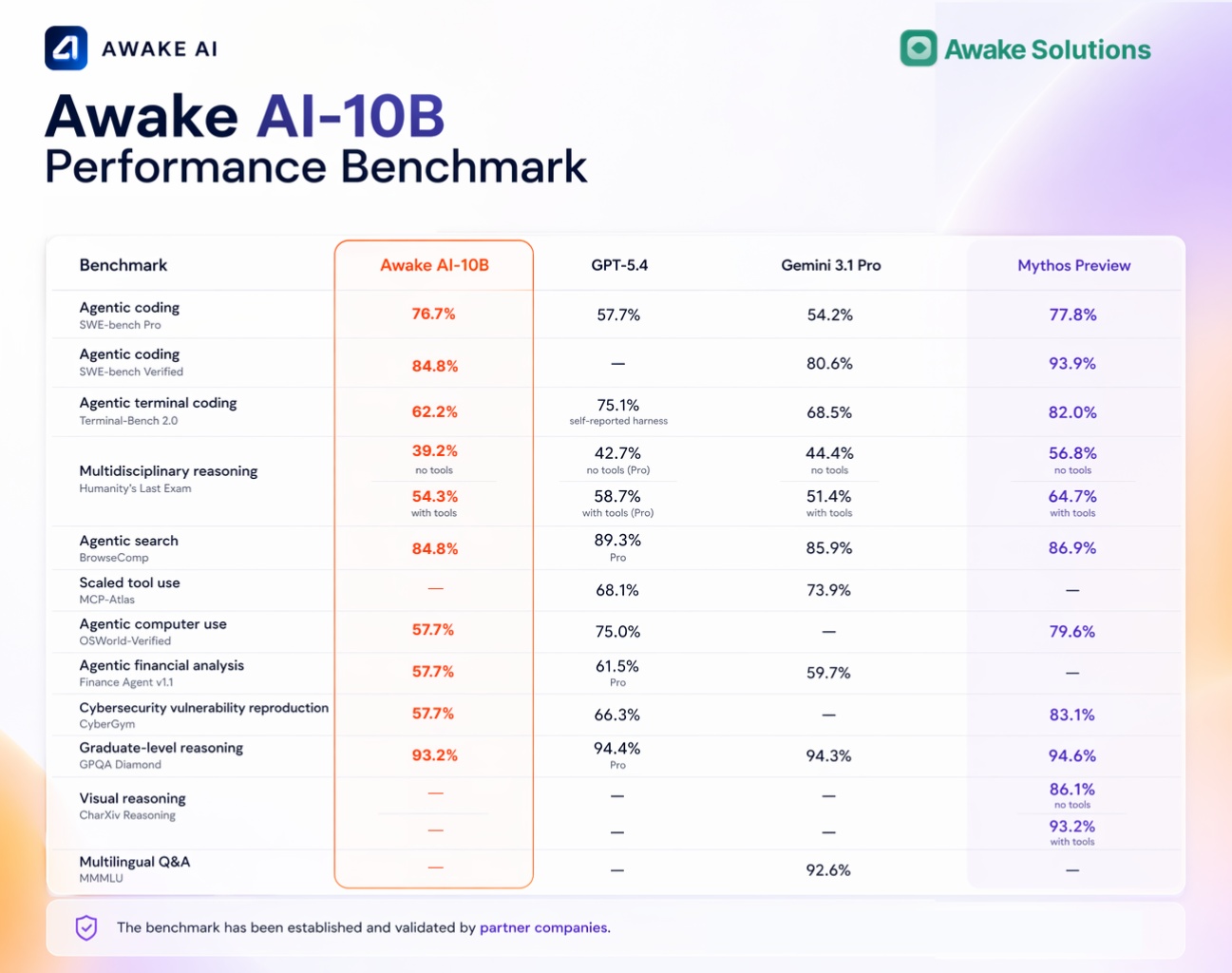
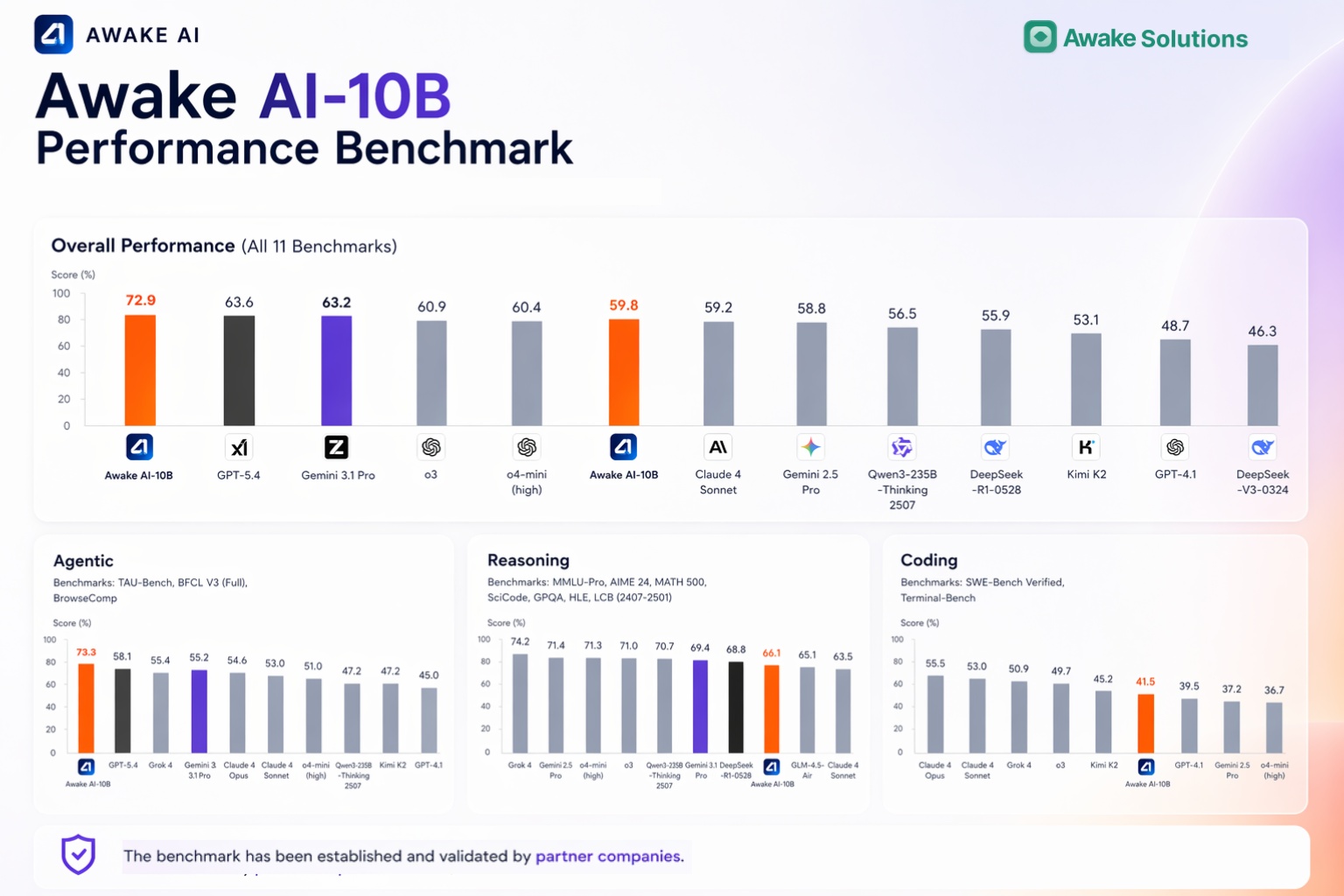
These results highlight the model’s strengths in delivering reliable, contextually relevant outputs across a variety of tasks and linguistic contexts, making it a versatile tool for both developers and enterprises.
Detailed evaluation results and benchmark comparisons are available in the full research paper, which provides an in-depth analysis of the model’s performance across various dimensions.
Use Cases
Awake AI-10B can be applied across conversational systems, developer tools, enterprise automation, and multilingual interfaces. Its adaptability enables it to function effectively in both user-facing applications and backend systems, supporting a variety of workflows and operational needs.
The model’s ability to combine reasoning, multilingual understanding, and structured output generation makes it suitable for building intelligent systems that require both flexibility and reliability.
Safety and Alignment
Awake AI-10B incorporates alignment strategies designed to improve response reliability and ensure outputs remain contextually appropriate. The model is trained to follow instructions responsibly while minimizing the generation of harmful or misleading content.
Ongoing refinement processes focus on improving robustness, reducing unintended behaviors, and enhancing the model’s ability to handle sensitive or ambiguous inputs. These efforts contribute to a more stable and predictable system that can be trusted across a wide range of applications.
Limitations
While Awake AI-10B demonstrates strong general capabilities, it may produce inaccurate or incomplete responses in cases involving highly specialized knowledge or insufficient context. Like other large language models, it does not possess real-time awareness unless integrated with external data sources.
Performance may vary depending on input clarity and domain specificity, and outputs should be evaluated in scenarios where accuracy is critical.
Conclusion
Awake AI-10B represents a step toward efficient, scalable, and multilingual AI systems designed for real-world deployment. By combining strong reasoning capabilities with bilingual intelligence and optimized performance, the model enables developers and organizations to build advanced AI-driven applications that are both accessible and reliable.
Awake AI-10B represents a step toward accessible, high-performance AI systems designed for both regional and global applications.